
People sometimes ask what a typical day looks like for one of our diabetic alert dogs in training.
The easiest answer is that there really isn't one.
One day might include a trip to a store or restaurant. Another might include time around children, a busy public place, an appointment, a car ride, or training closer to home. There are obedience sessions, scent training, public access work, playtime, meals, naps, and plenty of ordinary everyday life mixed in between.
What that day looks like also depends quite a bit on the age and stage of the dog.
A younger dog is building his foundation. He is learning routines, basic manners, how to respond to his trainer, and how to be comfortable experiencing the world around him. An outing at this stage may be short and have a very simple goal. We may simply want him to experience automatic doors, hear shopping carts, walk on a new surface, see different people, and leave feeling comfortable about the experience.
But a lot of that early learning happens right at home too. A young dog has an entire household to get used to. The blender suddenly comes on. The vacuum moves around the room making all kinds of noise. Cabinets open and close. Doors shut. Brooms sweep across the floor. Things get dropped. People move from room to room. These are completely ordinary parts of everyday life to us, but they aren't necessarily ordinary to a young dog who hasn't experienced them before. We want those things to become just that. Ordinary.
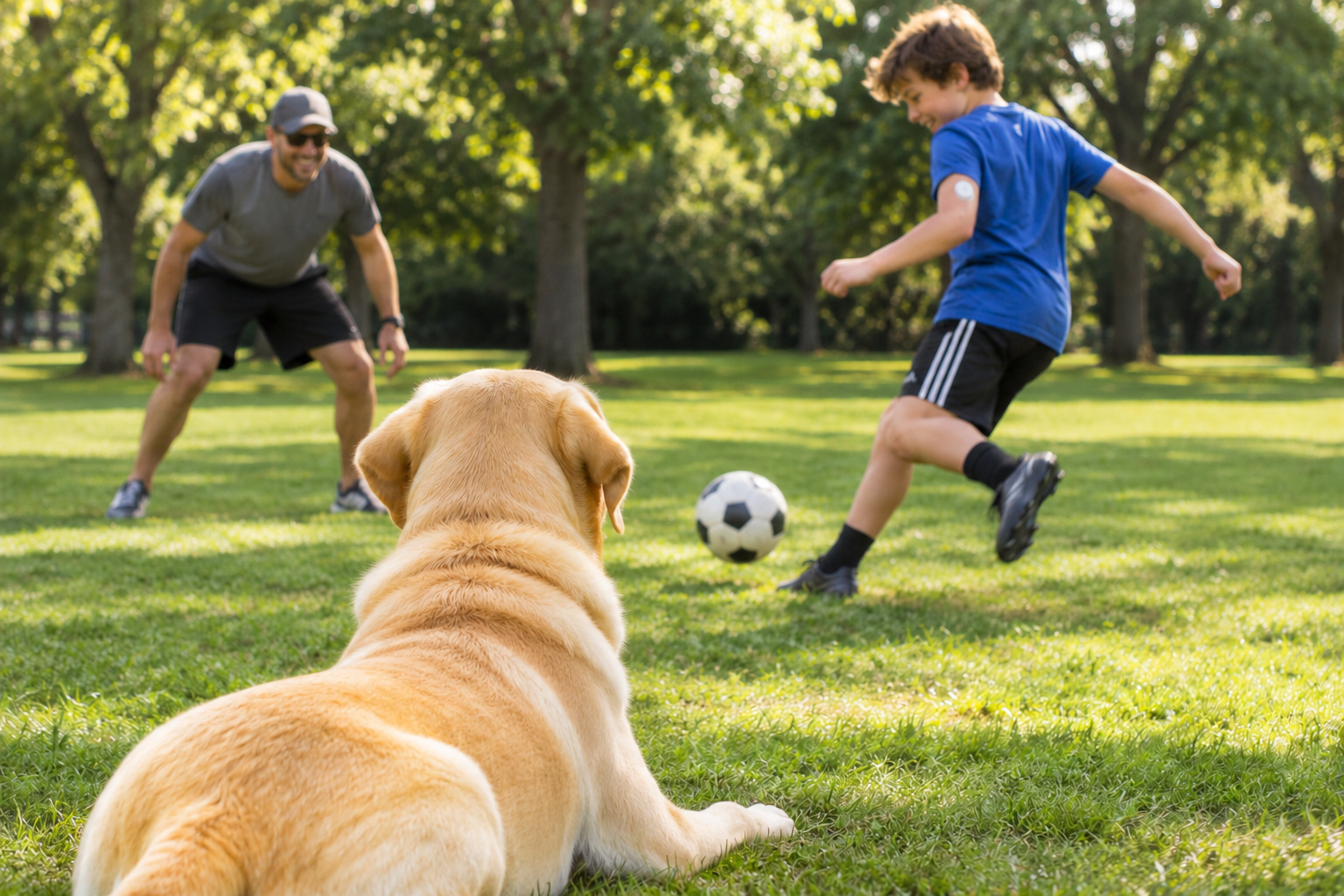
For our dogs, that early experience also includes spending time around children. Children don't move or behave like adults, and a dog who may eventually work with a child needs opportunities to become comfortable with that. Kids run. They yell. They laugh and squeal. They toss toys, make odd noises while they play, suddenly change direction, and have an amazing ability to appear seemingly out of nowhere and disappear just as quickly.
To us, that's just kids being kids. To a young dog, it's a lot to take in.
So being around children playing can be an important learning experience all by itself. A younger dog doesn't need to participate in everything happening around him. Sometimes the lesson is simply learning that children can run past, a toy can fly across the room, someone can suddenly squeal with excitement, and none of it is something he needs to chase, investigate, or worry about. Over time, all that activity starts becoming normal.
As he gets older and his skills develop, we gradually ask for more. Outings can become longer and environments more challenging. We expect more from his obedience, settling, focus, and ability to work around distractions. His scent training develops along with those other skills.
Eventually, those pieces have to come together. He isn't just learning how to behave appropriately in public. He needs to become comfortable enough in different environments that he can still pay attention to his handler, monitor him, and alert when needed.
Think about everything a dog has to get used to just walking into a store. Voices and music may suddenly be coming from speakers overhead. The flooring may change from concrete to tile to carpet. Automatic doors open and close. Shopping carts rattle past. There are unfamiliar smells everywhere. People approach from different directions. Displays may move or make noise. Something may fall on the floor. A child may run past. Then there are all the sounds and smells that we barely notice because we've experienced them thousands of times, but a dog hasn't.
At first, some of those things may deserve his attention simply because they're new. With experience, they become part of the background. That's what we want. We don't need him spending all of his attention wondering where that voice overhead came from or what that strange floor feels like under his feet. Eventually, those things need to become ordinary enough that he can move through the environment comfortably and still have his attention available for the person he is there to help.
But what I think surprises people is how much of that training doesn't really look like training at all.
If you see one of our dogs lying quietly under a table, for example, it might look like he's doing nothing. But doing nothing and looking like you're doing nothing aren't necessarily the same thing.
He may be resting quietly while still watching, smelling, listening, and remaining aware of the person beside him. Eventually his job will need to happen while normal life is going on around him. His handler's glucose isn't going to wait until the room is quiet and everyone is ready.
Some of the most important lessons are even less exciting to watch. Waiting politely at a doorway, getting in and out of the car appropriately, ignoring food that falls on the floor, walking past another dog without needing to say hello, and settling while people have a conversation are all part of the process.
None of those moments would make a particularly exciting training video, but put hundreds of those little moments together and you begin to see why everyday life is such an important part of training.
Of course, there is formal training too. Our dogs work on obedience, leash skills, recalls, stays, positioning, public access behaviors, and other skills they will need as service dogs. Our diabetic alert dogs also receive specialized scent training as part of their preparation.
Learning those skills in a quiet environment is one thing. Being able to use them when life is happening around the dog is another. Can he still settle when someone drops a french fry nearby? Can he stay focused when a child runs past? Can he walk calmly past someone who desperately wants his attention?
Those everyday situations give us opportunities to build on what he already knows. They also give us information about the dog himself. Every dog is an individual. We learn what comes easily to him, what requires more practice, what distracts him, how quickly he adjusts to something new, and where he needs more experience. That information helps guide his training as he continues to mature.
Those everyday moments aren't all about asking something from the dog either. There is plenty of affection mixed into our days too. Our dogs get loved on, pet, played with, talked to, and spend time just having fun with their trainers. We're building a relationship with them while we're training them, and that relationship matters. A dog who enjoys being with you, trusts you, and wants to engage with you is much easier to teach than one who sees every interaction as another training session.
And yes, there are breaks. Our dogs play, exercise, explore, sleep, and get time to simply be dogs. We talked quite a bit about that in What Is Your Diabetic Alert Dog Doing When They're Off Duty? Rest and downtime are part of their lives too.
When you look at a service dog working quietly beside his handler, it's easy to notice the big things, such as the beautiful obedience, the calm behavior in public, or the alert that gets everyone's attention. What you don't see are all of the little experiences that came before them.
You don't see the doorway he learned to wait at, the shopping cart he had to learn to walk next to, the sounds he had to get used to, or the stranger he learned to ignore. You also don't see all those times he appeared to be doing very little while he was actually learning to quietly watch, smell, listen, and pay attention.
That's why it's difficult to describe a typical day in the life of one of our diabetic alert dogs in training. There isn't one big training moment that prepares a dog for his future. There are hundreds of little ones, and over time, those little moments begin to come together as we prepare him for one very important job and the person who will someday be counting on him.
Ron Santo knew what it meant to live every day with diabetes, but he also believed diabetes shouldn't keep someone from living a full life. That experience was a big part of why helping others with diabetes became so important to him.
I think that's where all of these seemingly small training moments connect back to Ron and what the Foundation continues to honor. Someday there will be a child on the other end of that leash with school to attend, friends to see, places to go, sports to play, vacations to take, and all of the ordinary things that make up a childhood.
We're not simply preparing a dog to work. We're preparing him to become part of that child's everyday life, giving that child another layer of support with their diabetes while they are busy doing something much more important...being a kid.